Welcome Randy Hemingway, Sales Manager, Northeast

Randy HemingwayPlease join us in welcoming Randy Hemingway to the Equicare team!  Randy has enjoyed an incredibly varied career in the field of oncology including roles as Director of Oncology, Dosimetrist, and Sales Manager.  He’s worked all over the world, delivering health technologies and we’re thrilled he’s now going to support healthcare providers in the Northeast.  Get to know Randy a little better here:

What was your first job?|
My very first job was in a butcher shop.  I really liked it because I got to interact with customers, and also learned what makes a great steak. I got pretty good at it, and in high school I even judged meat competitions! 

What are you most proud of in your career so far?
I’ve worked in International sales for over 14 years, and I’ve had the chance to introduce new healthcare technologies to Latin America, Europe, Asia, and South America.  It’s been incredibly enlightening for me to see how different each health system is, and yet how each shares common ground: a basic desire to provide best care for their patients.  While it’s been eye opening for me personally, it’s also been extremely rewarding to see how the technologies I’ve introduced change the operation of healthcare organizations, and ultimately improve the care patients receive.  Making a difference like that is something I’m very proud of.

What are you most looking forward to working on at Equicare?
I notice that while health technology is improving, we have tended to lose focus on the patient as a whole person.  In the US especially, we often treat immediate symptoms and localized problems first, which means we miss a lot of the dietary, emotional and psycho-social aspects of care.  At Equicare, we’re bringing in a continuum of care to oncology, and considering the patient’s needs in full.  This brings the patient to the center of care, which is very different from anything I’ve ever done.  This is really a monumental step for the healthcare providers, who have a more complete picture of their patient’s health, and for the patient, who can finally take a more active role in their health, confident they’re being treated like a complete person!  The fact that I have the chance to introduce these changes to the healthcare industry through Equicare is very exciting.

What do you think of the state of the Healthcare IT industry and its future?
I think that as a rule, we’ve seen a trend towards the generalization of healthcare IT, where technology comes top down from large, enterprise level systems.  While this has obvious administrative benefits, we often lose out on patient care – it’s just impossible for one of these large systems to meet the needs of oncology patients specifically.  What Equicare is doing, and what I think will become a trend, is to work from the bottom up, with a system ideal for treating specific patients, while also integrating into the larger hospital IT systems. Adding these specialized services will be a significant milestone improving relationships between patient, family, clinicians and PCPs.

The ability to track patients throughout their care is increasingly key to success.   This will be most significant in reducing the number of patients that drop between treatments, and never receive follow up.  Knowing where patients are in the process, addressing problems that arise, and sharing this information not only with other specialists, but also with the patient, again puts the patient back in the center of care.

Finally – the internet has completely changed the way we view our health.  Many patients, especially younger ones, will go online and do their own health research before even coming into a clinic.  While this  generally leads to a better educated patient population, we can’t control what kind of information patients are getting, or validate it’s accuracy.  I hope products like Equicare, which include up to date, clinical education can bridge the gap, so we can educate patients with information they can trust.

How have you seen technology improve the lives of those suffering from long term conditions or illnesses?
Specifically in oncology, I’ve seen amazing improvements in localized radiation therapy.  The ability to localize treatment has not only improved cure rates but dramatically reduced toxicities and secondary malignancies. I’ve also seen major improvements in information technology that enable us as a community to learn from our history so that we don’t repeat our mistakes.  The improvements in treatment and the increased availability of  information have enabled the healthcare community to see pretty dramatic improvements in health outcomes for cancer patients.

Now that we’re in the beginning stages of public healthcare in the US, I hope we don’t lose out on these improvements by generalizing treatment recommendations. Patients still have unique needs, and a one size fits all health system doesn’t address these issues.

What are you reading right now?
This might be boring, but mostly I read journals, and especially the Red Journal. Well that, and LOTS of emails!

You need to go on holiday tomorrow- where would you go?.
Paris and anywhere in Latin America are favorites, but if i had a choice to go anywhere, and the world were safer place I’d love to travel to Kathmandu, which is somewhere I’ve never been.

What would you eat for your last meal on earth?
I think I’ve come full circle to my first job: I’d definitely chose Filet mignon.

We’re pleased to have Randy and his expertise on our team. Want to get in touch about oncology care or the finer aspects of butchery? Please contact Randy at randy.hemingway@equicarehealth.com
 

Equicare Health announces a partnership with e+CancerCare

Equicare to provide integrated software that enables e+ to deliver coordinated Navigation, Survivorship & Patient Portal Services to their centers

Vancouver, BC – August 11 , 2014Equicare Health, a leading provider of care coordination software, is pleased to announce a partnership with e+CancerCare. Headquartered in Nashville, TN, e+ is one of the leading operators of outpatient cancer care centers, offering a variety of cancer imaging, chemotherapy, and radiation therapy services in their 23 sites including Rocky Mountain Oncology Center in Wyoming, OncoLogics in Louisiana, Community Cancer Center of North Florida, Laurel Cancer Care in Mississippi, South Georgia Center for Cancer Care and PET Imaging centers in Texas, Oklahoma and Colorado.  Through the partnership, Equicare will integrate the EQUICARE CS™ software suite into the entire e+ network, enabling the centers to provide navigation, survivorship and patient portal services.

Read more

Finding the ROI in Survivorship

Based on our experience, most oncology healthcare providers believe in the value of navigation and survivorship, and most patients appreciate having access to it. These services can help providers ensure patients receive the long-term care they need, and help patients play a more active role in their health. The Institute of Medicine has been advocating survivorship since their 2005 “Lost in Transition” paper, and the American College of Surgeons Commission on Cancer has now changed their accreditation requirements to include survivorship planning.

So why isn’t everyone doing it?  One of the most common obstacles organizations face is cost.  Managing a large-scale survivorship program usually requires the use of new electronic tools, and often hiring dedicated staff members. For many organizations, the investment is hard to justify, especially in a time of shrinking budgets.

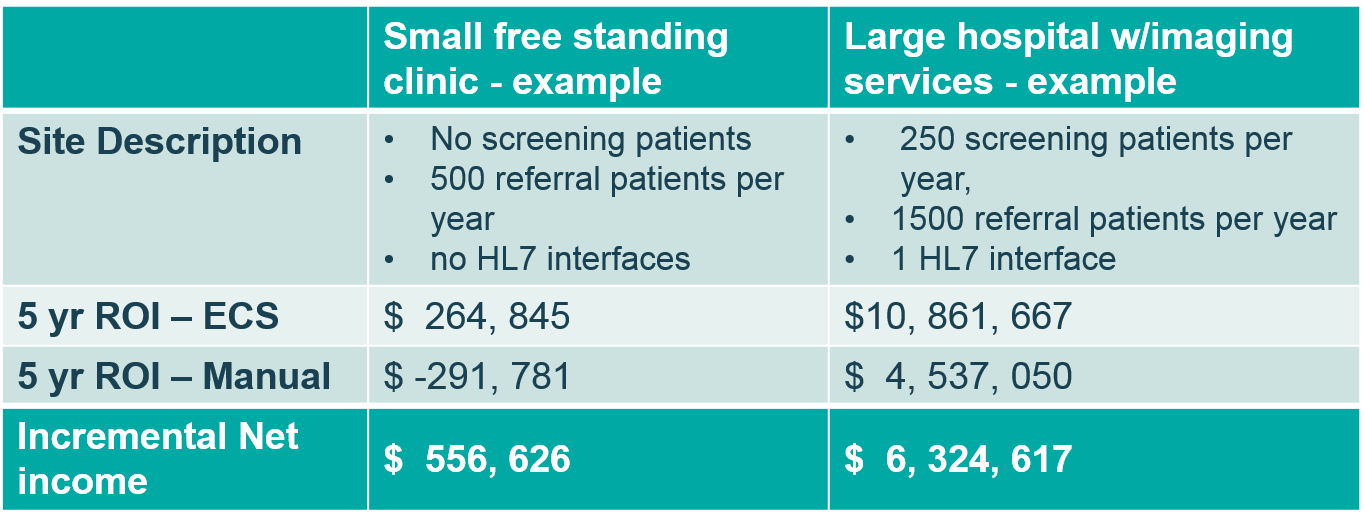
What many organizations don’t realize is that survivorship & navigation can actually deliver a return on investment, often within a few years of implementation. We are now pleased to introduce a Pro-forma tool that calculates what we expect this return to be. For example, take a look at the 5-year return from 2 fictitious, though typical, organizations below.

This tool was developed in partnership with American Medical Accounting & Consulting Inc (AMAC), one of the leading firms in the radiation oncology industry. Based on this reimbursement data, and information about the size, make-up and growth projections of an organization, we can calculate an expected 5-year ROI to help justify an initial investment. Although the data above is fictitious, it represents the real return organizations can expect to realize when using an electronic survivorship product like EQUICARE CS.

Don’t believe us?  Let us prove it!  Contact us to learn more about where these numbers come from and get an ROI calculation specific to your organization.

More questions?  We’ll try to answer some below:

  1. What’s the difference between incremental net income and ROI?
    The ROI is simply the difference between the total revenue and expenses of managing a survivorship program. The incremental net income is the difference between the ROI an organization realizes when using an electronic tool like ECS, and the ROI from running a manual survivorship program. This is an important figure to present when considering whether to introduce an electronic tool, or attempt a manual program.
  2. What is a manual survivorship program?
    In the table above, we reference a manual survivorship program – this is how we describe programs that are run using paper or excel spreadsheets. While it’s possible to run a program like this, it’s less efficient, and for some organizations, particularly free-standing clinics like the one in the example above, actually causes the organization to lose money.
  3. Where does the revenue come from?The major sources of revenue are from:
    • Increased rates of patient attendance at reimbursable follow-up appointments
    • Increased Nurse Navigator efficiency – fewer FTEs can manage the same (or more) patients
    • For hospitals with imaging – we include revenue from additional in imaging studies, which may have been lost without survivorship & navigation
  4. Do you include staff salaries in this calculation?
    Yes, we use your current size and plans for the growth of the program to estimate the number of nurse navigators (or other dedicated employees) required to manage the program now and in the years to come.  This is included in the expense calculation.

Equicare Health Introduces a Cloud-based Hosting Solution through a Partnership with Iron Medical Systems

Vancouver, BC – April 15, 2014Equicare Health, a leading provider of care coordination software, is pleased to announce a partnership with private medical cloud solutions provider, Iron Medical Systems. Through the partnership, Equicare now offers healthcare organizations the ability to host cancer survivorship tool, EQUICARE CS™ (ECS), in Iron Medical’s secure, world class cloud, which is uniquely built for radiation and medical oncology centers.  The Iron Medical Systems cloud offers an unequalled, HIPAA compliant security regime that features daily backups and a thermo-regulated steel vault protected by armed guards and biometric security.

Read more

Equicare Health installs EQUICARE CS™ at the Patricia D. and M. Scot Kaufman Cancer Center

Vancouver, BC, April 3, 2014, Equicare Health, the leading provider of care coordination software, announces the installation of EQUICARE CS at the Kaufman Cancer Center at University of Maryland Upper Chesapeake Medical Center based in Harford County, Maryland. The software was installed in December 2013 in order to improve the patient experience both during and after treatment by providing long term cancer survivorship care plans, patient navigation services, and an online patient portal.

Read more

Equicare Health installs Active Patient Portal at the Cancer Center of Hawaii

Vancouver, BC – January 15, 2014 – Equicare Health, a leading provider of care coordination software, announces the installation of Active Patient Portal at the Cancer Center of Hawaii.  The center, Hawaii’s only free-standing radiation cancer treatment center, launched the portal in December 2013 in order to empower patients and their families to play a more active role in their healthcare.  Active Patient Portal provides secure online access to healthcare information and includes a consolidated appointment calendar, up to date lab and test results, educational materials, questionnaires, care team contact information, and more.

Read more

ECS for Clinical Trials

EQUICARE CS (ECS) was original designed for cancer survivorship, but it’s powerful enough to support a wide variety of other applications, including, as we recently discovered, Clinical Trials.  How can you use a tool aimed at survivorship for clinical trials?

Well, during a recent product management meeting, the team got into this discussion about clinical trials because one of our newly installed customers was looking for organizational support for a trial.  Once we started talking about it, we quickly realized that ECS could easily be used to support clinical trials. So much of clinical trials work is keeping track of stuff – medical tests, appointments, data submissions etc. ECS was designed to help the clinician keep track of survivorship tasks, and clinical trials are like survivorship but with another level of detail – specific to clinical trials people

Read more

Workflow Analysis – Why do we do it?

The EQUICARE CS installation and support program includes a full analysis of your clinical workflow, conducted to ensure survivorship, navigation, and patient engagement tools  are incorporated into your daily operations effectively.  Finding a workflow that works for your organization important to the success of your  programs; and in fact, we think it’s so important that we employ a full time Workflow Specialist.  Meet Tricia Cox, former Nurse Navigator and ECS user, and current Clinical Workflow Specialist at Equicare.

Every organization is different, so Tricia works with each customer to develop workflow solutions that work for their unique needs.  What does that look like?  Tricia describes the process and how it can help below…

What does a workflow specialist do for customers?

I work with clients to determine what is working and what is not within their current workflow.  Usually that means I find processes that need to be added to benefit patients for navigation and/or survivorship care.  Many facilities are trying to incorporate new standards of care for distress screening or survivorship care, but others are trying to improve current models of care.  The ultimate goal is to improve the patient care process within the facility.

Do you have any examples of how a Workflow analysis helps customers?

Yes, I’ve got lots!

When one site began using the software, the nurse navigator was using check marks on paper to figure out her patient contacts.  She then entered her data into an excel spreadsheet to meet reporting guidelines for her administrative team.  After taking a look at her needs, I showed her how to use the report capabilities within our software and was able to generate excel spreadsheets and reports automatically—freeing her time to see more patients.

Another site self-identified workflow problems and so I went out for a site visit after they had been running for several months.  Upon visiting the facility, we mutually determined some workflow enhancements, like a centrally located print station and the consolidation of efforts between team members.  Often care providers are entrenched in their systems and find it difficult to see the problems, although they know they exist!

When does a workflow analysis usually occur?

I typically get involved with an institution or center once ECS has been purchased and decisions on implementation are being made.  We start this process with something called Kick off, and this is usually when the nuances of the software are presented.  I like to get involved as early as possible to better understand who is involved with patient care, what their roles are and how they currently impact their patients.  We have frequent calls/web interactions as we go over workflow.  I can go on site early in the process if we cannot figure out the workflow process via web calls, otherwise we can wait and have an on site visit closer to going live or after going live.  Ultimately the timing is driven by customer needs.

Why does Equicare feel so strongly about the value of Workflow Analysis?

This analysis makes a BIG difference to customers, usually by identifying ways to save time on administrative tasks, leaving more time to focus on patient care.  Planning  workflow is one of the tasks that may be overlooked by busy organizations, but taking the time to find out the most efficient was of using the software ultimately benefits not just the organization but the patients, by enabling more regular contact and follow up.

And from my perspective – I just love problem solving!  Every site is slightly different and so is their workflow, which is very appealing from a problem solving perspective. Each site uses software features differently and working to see what works best for each site is very gratifying. Ultimately, if we work to improve patient care and patient experience, everyone wins.

Please contact us to learn more about conducting a workflow analysis in your organization.

Equicare’s Movember team – the Mid-month update

Our team of Mo-bros has been furiously growing facial hair this month, courageously sprouting mustaches to support men’s health through Movember.  Two weeks ago they looked like this, but at the midway point in November we can officially report back – the mustaches have arrived.

Make sure our team isn’t mustachioed in vain – please donate to Movember  and support men’s health this month.  Click here to learn more about Movember,  or view our team page here.

Equicare's Movember team at the mid-way mark
Getting serious about men’s health

Welcome Heather Krengel, Sales Manager, Southeastern USA

logy to improve outcomes for patient.  She will manage the Southeastern USA sales region, and we’re thrilled to have her on board.

In addition to her extensive professional and clinical qualifications, we also learned that Heather has experience in lawn maintenance and a sweet tooth for coconut cake – we think she’ll fit right in here.  Get to know her here:

What was your first job?
Well there were no child labor laws back then…… I helped my brother mow grass and haul hay during a Mississippi summer (bad idea). He stiffed me a few times and I soon found that working in the local grocery store was much cooler!

What are you most proud of in your career so far?
My background is clinical Oncology. So definitely the fact that I have been able to help folks through some of the most difficult times in their lives with care, compassion, laughter, and grace. You can earn stripes on a resume, but nothing takes the place of holding the hand of a person who has reached the end stage of their life. Learning how to do that has given me a certain freedom in life.

What are you most looking forward to working on at Equicare?
I can’t wait to help educate cancer care sites on how to build strong successful navigation and survivorship programs that will serve them and their patients well for years to come. There is a clear, growing need for both of these right now, and folks need to know how it can be done well from the get-go.

What do you think of the state of the Healthcare IT industry  and how it relates to oncology?
The Oncology industry is booming! With the aging of the “baby boomers” and even the generation that followed, we are starting to need more and more health care. Thankfully there are more choices in treatments and technologies and increasing numbers of places in which to be treated. Healthcare IT is absolutely vital in order to link technologies together with sites and services to help give the patient the most beneficial outcome. It’s not “one stop shopping” any longer. Healthcare IT must be able to connect various networks together in order to follow and track that patient for best practices and outcomes. I’m so thankful to represent one of the software companies that can do just that.

How have you seen technology improve the lives of those suffering from long term conditions or illnesses?
I am a huge believer in early detection! Whether it be through genetic testing, age appropriate examinations, or preventive care, we could not have seen the survivorship and wellness numbers expand the way they have over the last couple of decades without the advances in technology. I have seen adults that were diagnosed with colon cancer or breast cancer who were able to spare their children the same fate due to a simple blood test – that’s the kind of technology that I can get excited about.

What are you reading right now?
The Boys in the Boat

You need to go on holiday tomorrow- where would you go?
New Zealand. I hear the hiking and people are amazing.

What would you eat for your last meal on earth?
That one is easy, my mother’s homemade coconut cake. Probably the entire thing.

Want to get in touch with Heather to discuss your survivorship and navigation program needs  (or just share your magic advice for managing a three year old)?  Heather will be be happy to hear from you at heather.krengel@equicarehealth.com

Top